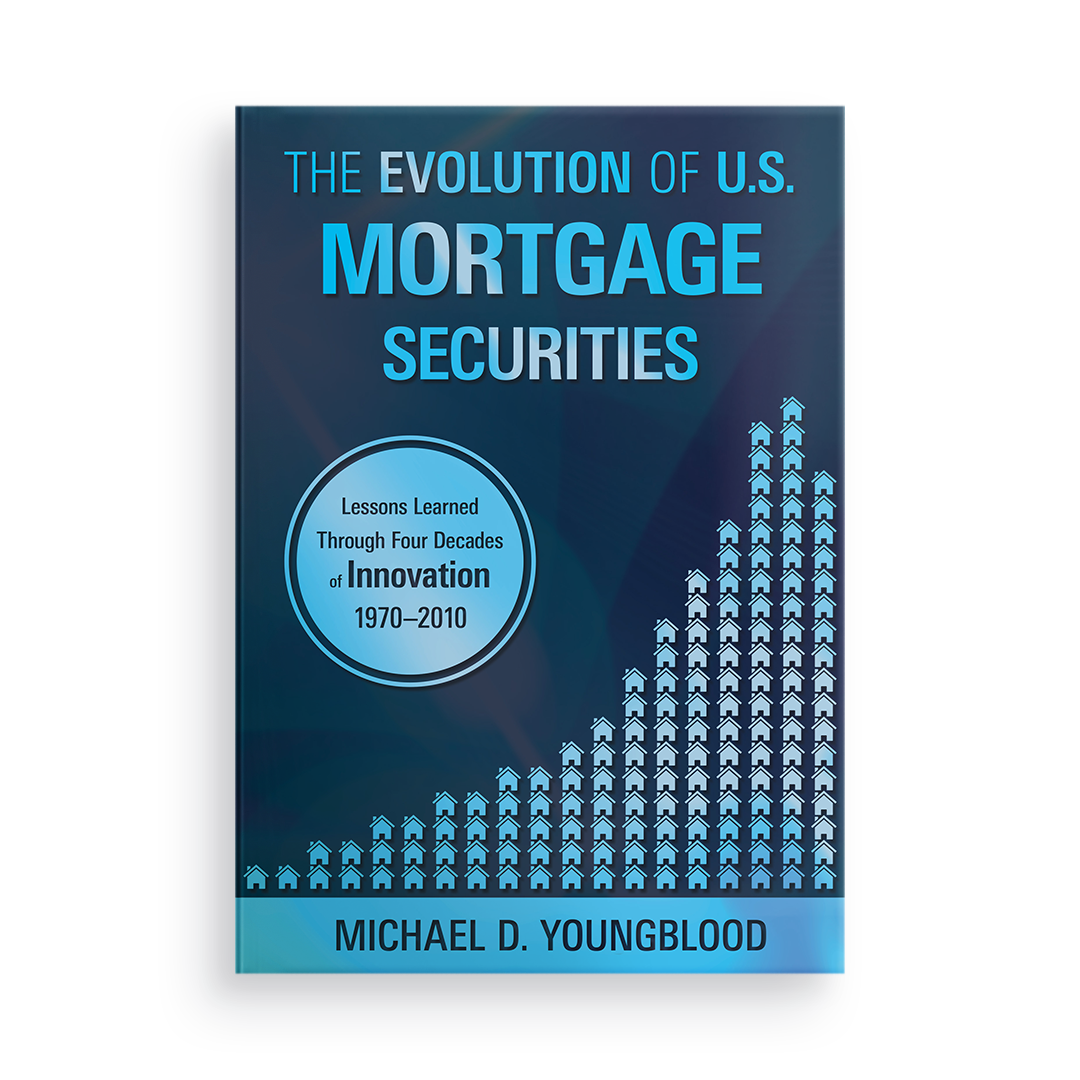
The Evolution of U.S. Mortgage Securities

$39.95

Discover the Four Vital Decades That Defined U.S. Mortgage Securitization

When Congress created Ginnie Mae through the Housing and Urban Development Act of 1968, it ushered in the first mortgage-backed security, an innovation that expanded access to homeownership nationwide. What followed was a dynamic journey through shifting economic and social forces as the architects of securitization labored to perfect the machinery by which the local mortgage market could go national-but not without profound trials.

In The Evolution of U.S. Mortgage Securities 1970-2010: Four Decades of Innovation, fintech entrepreneur Michael Youngblood applies his extensive experience in U.S. housing and mortgage markets to supply an essential history of the forty critical years when residential mortgage securitization underwent a heated laboratory of creativity. Through exhaustive research and detailed accounts, Youngblood illustrates how fragmented, local lending evolved into a vast, open marketplace by solving concrete problems: standardizing loans, spreading risk, and equalizing credit access. Beginning with FHA insurance and the first Ginnie Mae pass-through, Youngblood charts the build-out of agency programs, non-agency conduits, and multiclass CMOs/REMICs, showing how each product tackled funding mismatches, prepayment, and credit risk.

Part celebration of human ingenuity, part warning about the danger of forgetting hard lessons, Youngblood's history help us understand how future crises in mortgage lending may be averted through an honest examination of its origins and innovations, and a lasting dedication to the promise of home ownership across America.

Discover the Four Vital Decades That Defined U.S. Mortgage Securitization

When Congress created Ginnie Mae through the Housing and Urban Development Act of 1968, it ushered in the first mortgage-backed security, an innovation that expanded access to homeownership nationwide. What followed was a dynamic journey through shifting economic and social forces as the architects of securitization labored to perfect the machinery by which the local mortgage market could go national-but not without profound trials.

In The Evolution of U.S. Mortgage Securities 1970-2010: Four Decades of Innovation, fintech entrepreneur Michael Youngblood applies his extensive experience in U.S. housing and mortgage markets to supply an essential history of the forty critical years when residential mortgage securitization underwent a heated laboratory of creativity. Through exhaustive research and detailed accounts, Youngblood illustrates how fragmented, local lending evolved into a vast, open marketplace by solving concrete problems: standardizing loans, spreading risk, and equalizing credit access. Beginning with FHA insurance and the first Ginnie Mae pass-through, Youngblood charts the build-out of agency programs, non-agency conduits, and multiclass CMOs/REMICs, showing how each product tackled funding mismatches, prepayment, and credit risk.

Part celebration of human ingenuity, part warning about the danger of forgetting hard lessons, Youngblood's history help us understand how future crises in mortgage lending may be averted through an honest examination of its origins and innovations, and a lasting dedication to the promise of home ownership across America.

SPECS

  • Imprint: Brown Books Publishing Group

  • BISAC: History / United States

  • Format: Paperback

  • Page Count: 496

  • Publication Date: May 13th, 2026

  • ISBN-13: 9781612548166

  • Dimensions: 7” x 10”

  • US List Price: $39.95

  • Carton Qty: X

AUTHOR BIO

Michael D. Youngblood co-founded a pioneering analytics firm that advised the Federal Reserve, Fannie Mae, and other leading institutions on mortgage securities and market stability. His work has spanned the U.S., Europe, and Australia, where he has developed models, forecasts, and strategies that reshaped how financial institutions understand housing and credit risk. Alongside his corporate leadership, Mr. Youngblood has provided expert testimony, guided litigation teams, and mentored the next generation of analysts.

As an author, Mr. Youngblood has written extensively on housing finance, mortgage-backed securities, and financial markets, producing both academic studies and practitioner-oriented books that translate complex economic forces into accessible insights.

Michael Youngblood lives in Arlington, Virginia, where he continues to write, advise, and explore new applications of data science in finance and beyond.